
IPTV vs. Internet TV: The Battle for Content Rights and Licensing Models
Imagine a popular children’s animated series featuring a curious little girl named Paris and her adorable companion, Count Pitil de Patil, a monkey plush doll with a personality of his own. The show has become a favorite among young viewers, combining entertaining adventures with lessons about friendship, kindness and imagination.
Now imagine that two television companies in the United States want to broadcast this exact same series. One operates a traditional IPTV service, while the other runs an Internet TV platform. Both want to include the series in their children’s programming lineup and both are willing to pay for distribution rights.
Can the content owner license the same series to both companies? Can each receive exclusive rights? And how can two exclusive licensing agreements exist in the same country without contradicting each other?
To answer these questions, we first need to understand the differences between IPTV, Internet TV, and the licensing arrangements that govern content distribution.
IPTV and Internet TV: Understanding the Difference
Although IPTV and Internet TV both use Internet Protocol (IP) technology to deliver television programming, they traditionally operate through different distribution environments.
IPTV (Internet Protocol Television) refers to television services delivered through a managed IP network, typically operated by a telecommunications company or television service provider. The operator manages the network infrastructure and can control important aspects of service quality, security and delivery.
Internet TV, as used in this article, refers to television services delivered over the public internet. This is commonly associated with over-the-top (OTT) distribution, where viewers access television programming through an internet connection without relying on a dedicated, managed television network operated by the service provider.
The fundamental distinction is therefore the network environment, not the underlying technology. Both services use IP.
Industry terminology is not always consistent. Some providers use IPTV broadly to describe almost any television service delivered over an internet connection. Nevertheless, distinguishing managed-network IPTV from public-internet OTT distribution is useful when discussing content licensing.
One Animated Series, Two Different Television Services
An important concept in television licensing is that the distribution method does not determine the identity of the content.
Consider our fictional animated series, The Adventures of Paris and Count Pitil de Patil.
The series follows Paris, an imaginative young girl who explores the world with her beloved monkey plush doll, Count Pitil de Patil. Together, they discover new places, meet interesting characters, and learn valuable lessons.
Imagine that the series consists of 52 episodes and belongs to a fictional American production company called WonderTales Studios.
The company receives proposals from two television operators.
Company A: LibertyWave TV – The IPTV operator
LibertyWave TV operates a managed IPTV service for American households.
Its children’s television channel, Kids Galaxy, is distributed through LibertyWave’s managed IP network, typically using a television set-top box.
LibertyWave wants the rights to broadcast all 52 episodes of the animated series as part of Kids Galaxy’s regular programming.
Company B: StreamNest – The Internet TV Operator
StreamNest distributes television channels over the public internet.
Its children’s channel, ToonWorld, is available through smart TVs, streaming devices, computers and mobile applications.
StreamNest also wants the rights to broadcast the same 52 episodes as part of its scheduled programming.
Both companies operate in the United States, target families with young children, and want to broadcast the same animated series.
However, their distribution environments are different.
The key differences between the two television services, including their channels, distribution methods and typical access methods, are summarized in Table 1.
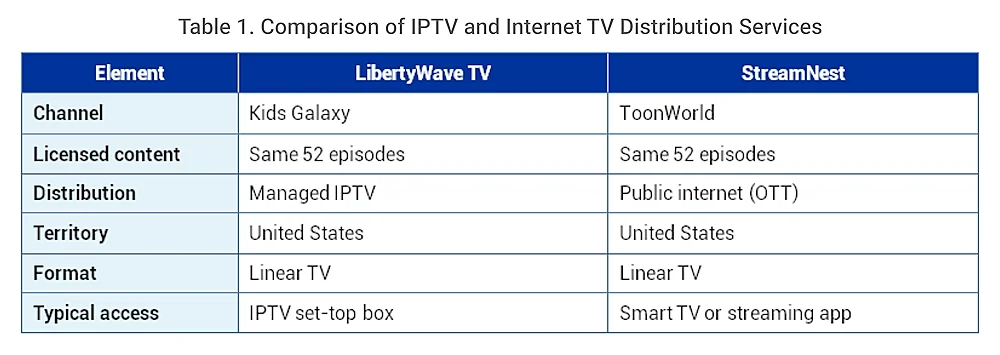
The important distinction is that the animated series is the content product, while Kids Galaxy and ToonWorld are two separate television services carrying that content.
Their feeds may have different schedules, advertisements, introductions and surrounding programming, even though both broadcast the same underlying intellectual property.
A channel is the branded television service, while a feed is the actual stream of programming transmitted through a distribution system. A single program can therefore appear on multiple channels and feeds without becoming different intellectual property.
IPTV and Internet TV Are Distribution Methods, Not Licensing Models
IPTV and Internet TV describe how television programming reaches viewers. They are not licensing models themselves.
A licensing model defines the legal and commercial arrangement under which a content owner authorizes another company to distribute or use its programming.
For example, WonderTales Studios owns the intellectual property associated with The Adventures of Paris and Count Pitil de Patil. It can negotiate separate agreements with LibertyWave and StreamNest.
These agreements may specify:
- The content and episodes being licensed.
- The geographical territory (and language).
- The license term (duration) of the agreement.
- Whether the rights are exclusive or non-exclusive.
- The permitted distribution methods.
- Licensing fees and revenue-sharing arrangements.
- Whether sublicensing is permitted.
- Whether additional rights, such as catch-up TV or VOD, are included.
The distinction matters because acquiring IPTV distribution rights does not automatically grant a company every possible television distribution right.
Likewise, receiving Internet TV rights does not necessarily authorize distribution through a managed IPTV network.
The exact permissions depend on the licensing agreement. For example, rights to broadcast a series on a scheduled linear channel do not necessarily include the right to offer its episodes through an on-demand library.
Why Separate IPTV and Internet TV Rights?
From a commercial perspective, separating IPTV and Internet TV rights can create additional licensing opportunities.
Imagine that LibertyWave wants exclusive access to the animated series within its managed IPTV service, while StreamNest wants exclusive access through its public-internet television channel.
WonderTales Studios could potentially negotiate two separate agreements as illustrated in Table 2:
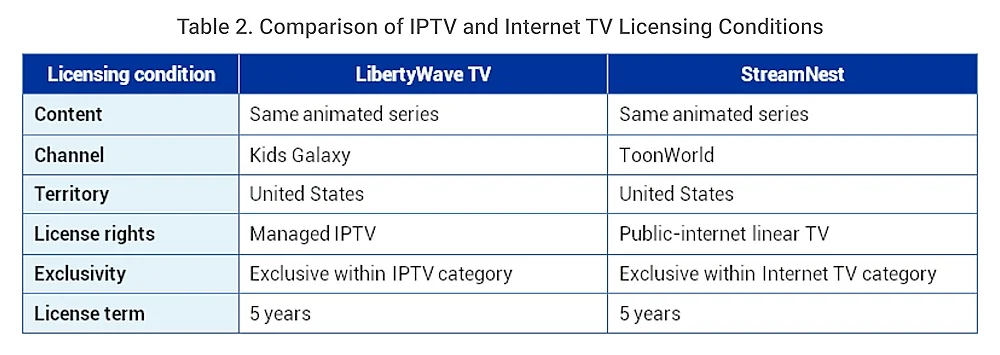
Under this hypothetical arrangement, LibertyWave receives exclusive rights within the defined IPTV category, while StreamNest receives exclusive rights within the defined Internet TV category.
Both companies can therefore hold exclusive rights within their respective distribution categories without necessarily having exclusivity across all television platforms.
This distinction can benefit content owners in several ways:
🗹 Expanded distribution
Licensing the same series to different operators can increase its potential audience and household reach.
🗹 Increased licensing revenue
Different operators may be willing to pay different fees depending on their subscriber bases, business models and commercial expectations.
🗹 Access to different markets
Separate agreements allow content owners to work with operators that have different customer bases, devices, subscription packages and advertising strategies.
🗹 Greater commercial flexibility
A carefully defined licensing agreement can prevent a single operator from obtaining broader exclusivity than the content owner intends to grant.
However, the content owner must actually possess the necessary rights, and the existing agreements and applicable law must permit this division.
Can Two Companies Have Exclusive Rights in the Same Country?
This is perhaps the most interesting licensing question.
Can WonderTales Studios grant LibertyWave exclusive IPTV rights and StreamNest exclusive Internet TV rights for the same animated series, territory, language and period?
Potentially, yes.
The key is understanding what each company receives exclusively.
Suppose LibertyWave’s agreement grants it exclusive rights to distribute the series through managed IPTV networks in the United States.
StreamNest’s agreement, meanwhile, grants it exclusive rights to distribute the same series through public-internet linear television services in the United States.
Both agreements cover:
- The same animated series.
- The same 52 episodes.
- The same territory and language.
- The same five-year period.
Yet their distribution categories are different.
LibertyWave’s exclusivity applies to managed IPTV, while StreamNest’s applies to public-internet television.
The content owner is therefore not necessarily granting two companies the same exclusive right. It is granting different, separately defined distribution permissions for the same intellectual property.
However, these categories must be clearly defined to avoid overlapping rights or contractual disputes.
What if one company wants broader exclusivity?
The situation becomes more complicated if LibertyWave argues that its exclusive IPTV agreement should also prevent the series from appearing on Internet TV services.
From LibertyWave’s perspective, the animated series makes Kids Galaxy more attractive to subscribers. If StreamNest can broadcast the same content on ToonWorld, LibertyWave may believe the commercial value of its exclusivity has been reduced.
LibertyWave might therefore request broader rights covering:
- Managed IPTV.
- Public-internet television.
- Streaming applications.
- Third-party internet platforms.
- Other forms of IP-based television delivery.
WonderTales Studios would need to decide whether to grant those broader rights, negotiate a higher licensing fee or retain the ability to license Internet TV distribution separately.
This illustrates why exclusivity must be defined by the specific rights granted rather than treated as a simple yes-or-no condition.
Conclusion: One Animated Series, Multiple Distribution Opportunities
IPTV and Internet TV are not different types of content, nor are they licensing models in themselves. They describe different television distribution environments.
The example of The Adventures of Paris and Count Pitil de Patil demonstrates how the same animated series can appear on two separate children’s television channels in the United States.
One channel, Kids Galaxy, is distributed through LibertyWave’s managed IPTV network. The other, ToonWorld, is delivered through StreamNest’s public-internet television service.
Both channels can have different feeds, schedules and commercial arrangements while broadcasting the same underlying program.
This creates the possibility of separate licensing agreements. WonderTales Studios could potentially grant LibertyWave exclusive managed-network IPTV rights while granting StreamNest exclusive public-internet linear television rights for the same series, territory, language and period.
However, this arrangement depends on the rights available to the content owner, existing agreements, applicable law and clear contractual definitions.
Ultimately, the key is to distinguish between the content being licensed, the television service carrying it and the infrastructure delivering it.
As IPTV, Internet TV and hybrid streaming platforms continue to converge, understanding these distinctions will become increasingly important for protecting exclusivity, negotiating licensing agreements and maximizing the commercial value of television content.
Managing complex distribution rights requires more than carefully written licensing agreements; it also requires the right tools to track rights, territories, languages, restrictions, exclusivity and content availability. MediaRights by MediaLogiq Systems is a powerful, web-based rights management solution designed to help media companies, content owners, distributors and sales agents manage their licensing activities with greater accuracy and efficiency.
With features such as precise availability calculations, real-time conflict checking, customizable rights classifications, holdback management, contract tracking and automated notifications, MediaRights helps distribution teams stay informed and avoid potential licensing conflicts before they become costly problems.
Whether you are licensing the same content across IPTV, Internet TV, VOD or multiple distribution platforms, MediaRights provides the tools to manage your rights portfolio and make smarter licensing decisions.
Discover how MediaRights can simplify your content licensing operations and help you maximize the value of your media rights. Visit MediaLogiq’s website or contact us to learn more or schedule a demonstration.