

Content Identification and Enforcement Rights in MediaRights
Digital distribution has made it easier than ever for movies and TV programs to reach audiences around the world. At the same time, it has created new rights-management challenges for content owners and distributors. A program may be legitimately licensed to one distributor while unauthorized copies, clips or full episodes appear on digital platforms.
This is where content identification and enforcement rights become important.
What Is Content ID?
Content ID is a digital content identification technology used by online platforms to recognize copyrighted audio and video. It allows rights holders to provide reference copies of their content so that the platform can automatically identify when that content or portions of it, appear in uploaded videos.
YouTube’s Content ID is the most widely known example. When a rights holder delivers a movie, TV episode, music track or other reference file to YouTube’s Content ID system, the system creates a digital reference or fingerprint, that can be used to identify matching material in videos uploaded by users.
For example, a rights holder may provide the reference file for a television episode. If another user later uploads the episode or a video containing a substantial portion of it, the platform can compare the upload against the reference and identify a match. The rights holder can then apply the policy associated with that content.
Depending on the rights holder’s settings and the applicable agreements, the response to a match can include:
- Block — restrict or prevent the matched content from being viewed.
- Monetize — allow the video to remain available while generating advertising revenue for the rights holder.
- Track — allow the content to remain available while collecting information about its use and performance.
Content ID therefore provides more than simple copyright detection. It gives rights holders a way to manage and exercise their rights at scale across large volumes of user-uploaded content.
Content ID in Film and Television
For movie and TV distributors, content identification can be particularly valuable because audiovisual content can be copied and redistributed across multiple digital platforms. A single movie or episode may appear as a full unauthorized upload, a clip, a compilation, a translated version or as part of another piece of content.
Automated identification allows rights holders to monitor these uses without relying exclusively on users or employees to find each instance manually.
Importantly, having Content ID or similar identification capabilities does not by itself determine who has the underlying distribution rights to a program. A distributor may have the right to distribute and monetize an authorized copy of a program through AVOD while a different party may hold the contractual right to identify and enforce against unauthorized uses of that same program.
This is why Content Identification and Enforcement Rights should be considered separately from traditional VOD exploitation rights. Recording these rights explicitly allows a licensing organization to establish who can exercise them, for which products, in which territories and for what period.
Content Identification and Enforcement Rights
It is important to distinguish Content Identification and Enforcement Rights from other digital exploitation rights.
For example, AVOD rights give a distributor the right to make a program available through an advertising-supported service and generate advertising revenue from that exploitation. Content Identification and Enforcement Rights address a different question:
Who has the right to identify and enforce against unauthorized digital uses of the content?
A distributor may therefore have both rights, but they do not necessarily have to be granted together.
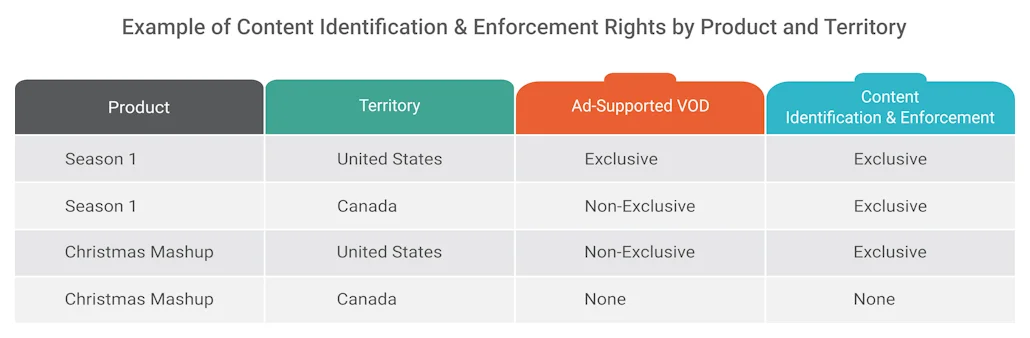
These rights can also vary by product and by territory. A distributor might, for example, have exclusive AVOD rights to a season in one territory while another party holds Content Identification and Enforcement Rights for a particular special or mashup.
The following example illustrates how these rights can be defined independently and managed at the product and territory level:
This distinction becomes particularly important when a catalog contains related products, such as individual episodes, seasons, specials, compilations, clips or mashups. Rights to one product may overlap with or affect the exploitation of another.
For example, a distributor with exclusive AVOD rights to a season may legitimately distribute an episode that is later incorporated into a separately licensed mashup. If another party receives exclusive Content Identification and Enforcement Rights for that mashup, the two sets of rights need to be coordinated to prevent conflicting enforcement or unintended restrictions on legitimate exploitation.
Recording these rights explicitly in the licensing agreement—and tracking them separately in the rights-management system—helps ensure that each party’s contractual rights are respected.
Including Content Identification and Enforcement in VOD Licensing Contracts
As digital exploitation becomes a larger part of film and TV distribution, licensing contracts need to account for more than traditional VOD rights.
A VOD agreement may specify rights such as:
- SVOD
- TVOD
- AVOD
- FAST
- Digital download
- Digital platform distribution
- Content identification and enforcement
Including Content Identification and Enforcement Rights as an explicit right in the acquisition or licensing agreement can help eliminate ambiguity about who is authorized to act when the licensed content appears elsewhere digitally.
The contract can specify the right:
- per product — for example, a specific movie, episode, season or special;
- per territory — such as the United States, Canada or a group of territories;
- per platform or service, where relevant;
- for a defined term; and
- on an exclusive or non-exclusive basis.
This is particularly useful when different products within the same catalog have different rights holders or different contractual restrictions.
Why This Matters
Suppose a distributor has exclusive rights to Season 1 of a series in a particular territory. One episode is later incorporated into a Christmas Mashup. The mashup may be treated as a separate product with its own licensing arrangements.
If the Christmas Mashup is granted to another party with exclusive Content Identification and Enforcement Rights, that party’s enforcement activities could potentially affect the distributor’s legitimate exploitation of Season 1.
Explicitly recording these rights in the licensing system makes such conflicts easier to identify and manage.
Managing These Rights in MediaRights
This is where MediaRights can help rights teams move beyond simply recording traditional VOD rights.
MediaRights provides a flexible framework for managing Content Identification and Enforcement Rights alongside other acquisition and licensing rights.
Instead of treating digital enforcement as a generic attribute of a title, MediaRights can capture the right at the appropriate level of granularity—by product and by territory.
This means that a rights team can distinguish, for example, between:
Season 1 — United States — AVOD: Exclusive
and:
Season 1 — United States — Content Identification & Enforcement: Exclusive
The two rights can be managed independently while remaining part of the same rights record.
The same approach can be applied to individual episodes, specials, compilations, mashups and other products. This gives rights managers a clearer picture of who owns which digital rights, where those rights apply and whether they are exclusive or non-exclusive.
Flexible Rights Management for Evolving Digital Rights
Digital rights are constantly evolving. New platforms, new monetization models and new enforcement technologies continue to create rights that may not fit neatly into traditional licensing categories.
A rights-management system therefore needs to be flexible enough to accommodate these changes.
With MediaRights, Content Identification and Enforcement Rights can be incorporated into acquisition and licensing workflows alongside established VOD rights. Rights teams can record these rights as part of the contractual framework and manage them according to the relevant product, territory, term and exclusivity.
This flexibility helps organizations ensure that the rights recorded in their system reflect the rights actually granted in their contracts—not simply a generic set of rights assumed to apply to every product.
Turning Digital Rights Into Actionable Data
Content identification and enforcement are increasingly important components of digital content distribution. But their value depends on knowing exactly who has the right to exercise them.
By explicitly including Content Identification and Enforcement Rights in acquisition and licensing contracts—and by tracking those rights at the product and territory level—media organizations can create a clearer connection between their contracts and their digital enforcement activities.
MediaRights provides the flexibility to capture and manage these rights as part of the broader rights lifecycle, helping rights teams keep digital enforcement aligned with the contractual rights they have actually acquired and licensed.
Visit our website or contact us to learn how the platform can support your business.